Deep Winter orDeep Autumn?
Both sub-seasons are built on depth. The tie-breaker is what's underneath it — cool clarity or warm richness.
Deep Winter and Deep Autumn describe almost the same person on paper: dark hair, deep expressive eyes, coloring with weight and presence. Both palettes are dominated by dark, powerful shades — which is why so many deep-colored people have worn both labels. The real difference sits underneath the depth. Deep Winter is dark plus cool plus clear. Deep Autumn is dark plus warm plus rich. Here's how to find out which foundation is yours.


3,000+
happy clients
Same Depth, Different Foundation
Deep Winter and Deep Autumn describe almost the same person on paper: dark hair, deep expressive eyes, coloring with weight and presence. Both palettes are dominated by dark, powerful shades — which is why so many deep-colored people have worn both labels. The real difference sits underneath the depth. Deep Winter is dark plus cool plus clear. Deep Autumn is dark plus warm plus rich. Here's how to find out which foundation is yours.
Depth is the loudest feature of both sub-seasons, and it drowns out the quieter signals. Because dark colors 'work' on both, a Deep Autumn can wear Deep Winter's black-and-jewel wardrobe for years without obvious disasters — and vice versa. The cost isn't a visible clash; it's a persistent small discount on how good you could look.
Underneath the shared depth, the two run on different engines. Deep Winter runs on contrast and coolness: it wants black against white, saturated jewel tones, icy accents — color with edges. Deep Autumn runs on warmth and richness: it wants espresso, rust, olive, and gold — color with glow. Winter's darks are blue-based; Autumn's darks are brown-based.
The practical stakes concentrate in the staples: your dark coat, your work trousers, your go-to lipstick, your metals. Get the foundation right and every dark piece you already own either earns its place or reveals itself as the other sub-season's uniform.

What is the difference between Deep Winter and Deep Autumn?
Both are dark, high-impact sub-seasons. Deep Winter is dark plus cool and clear — black, pure white, sapphire, emerald, blue-red. Deep Autumn is dark plus warm and rich — espresso, rust, olive, mustard, antique gold. Same depth, opposite undertone.
Where the Two Deep Palettes Separate
Deep Winter's Cool Edge
The shades a Deep Autumn can't own. Black and pure white worn together, icy accents, jewel tones at full saturation — these need cool, high-contrast coloring underneath. On a Deep Winter they look sharp and intentional; on a Deep Autumn they look severe.
Deep Autumn's Warm Edge
The shades a Deep Winter can't own. Rust, mustard, olive, and bronzy golds need golden warmth underneath to glow. On a Deep Autumn they look rich and expensive; on a Deep Winter they look muddy and dull.
The Shared Darks (Safe, Not Diagnostic)
Very dark shades near the cool-warm border pass on both sub-seasons — burgundy and aubergine especially. Wear them freely, but don't use them to type yourself: they flatter both faces about equally and settle nothing.
The Micro-Pairs That Decide It
Identical depth, opposite temperature. Test each pair against your bare face in daylight and watch skin evenness and under-eye shadows, not the fabric. Three consistent winners is your answer.

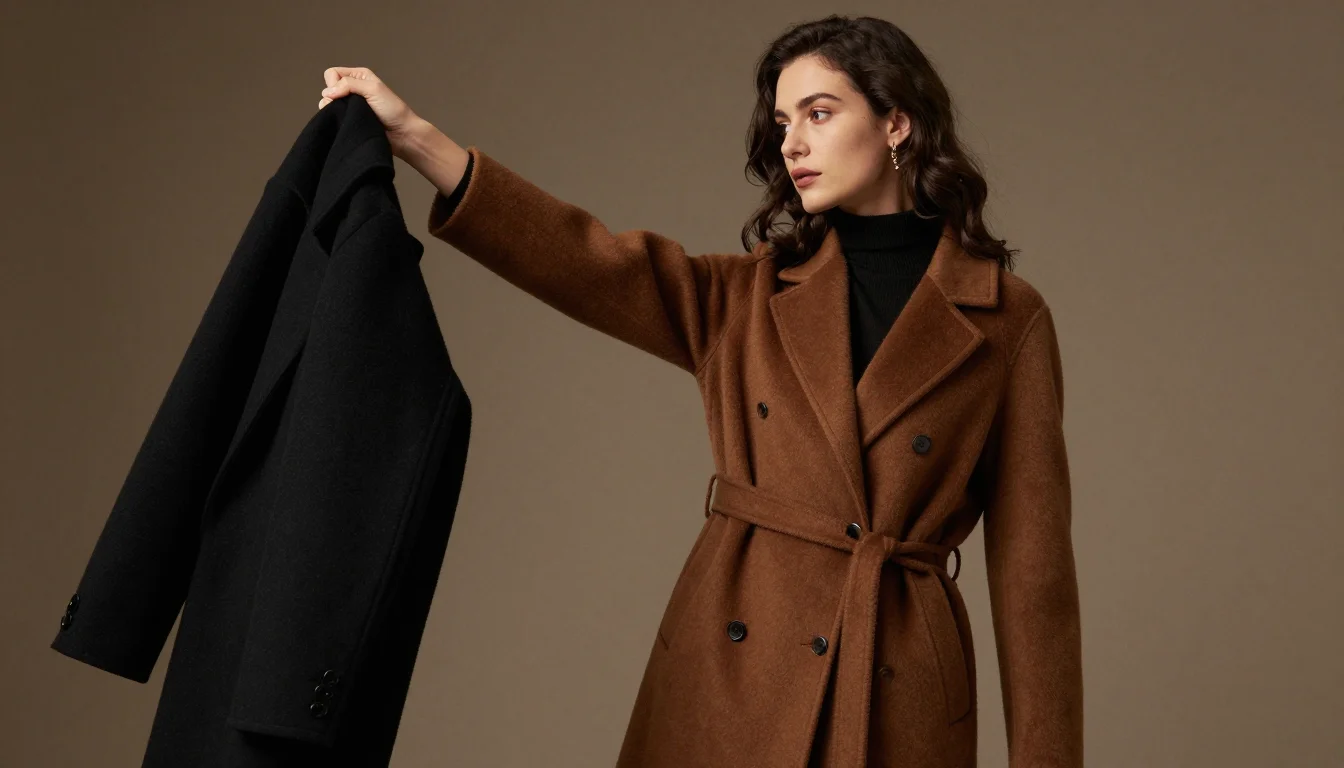
Black coat or brown coat? See both on your photos
Start my color analysisHow to Run the Deep Tie-Breaker at Home
The black coat versus brown coat test
The most consequential version of the test, because coats sit right at your face all winter. Try black, then espresso or chocolate, in daylight. Deep Winter: black crisps your features. Deep Autumn: the brown removes years of tiredness the black was adding. Buy the winner.
The gold test, done properly
Use antique or yellow gold versus polished silver, in daylight, against bare skin. Deep coloring can mute the signal, so look specifically at whether the metal blends into your skin (yours) or floats on top of it (not yours). Deep Autumns absorb gold; Deep Winters reflect silver.
Check what your eyes do
Both sub-seasons have deep eyes, but they respond to different fuel. Deep Winter eyes flash against jewel tones and black — the whites of the eyes brighten visibly. Deep Autumn eyes ignite against olive, rust, and bronze — amber flecks appear that black never finds. Take photos in each and compare the eyes, not the outfit.
Read your hair in direct sun
Near-black and dark brown hair looks identical indoors for both types. Sunlight separates them: blue-black or ash-dark sheen with no warm glint points Deep Winter; red, chestnut, or golden threads lighting up points Deep Autumn. Childhood photos in sunlight are even more reliable.
Deep Winter or Deep Autumn — find out for sure
The depth is obvious; the undertone is the question. Take the free color analysis quiz and get your exact sub-season.
Signs You've Picked the Wrong Deep Season
Black-and-white contrast feels harsh on you (you might be Deep Autumn)
Deep Winters are the poster children for black-on-white. If that combination makes you look stern or shadowed rather than striking — and swapping the white for cream instantly softens the effect — your foundation is warm.
Rust and mustard dull your face (you might be Deep Winter)
Deep Autumn's spice shades need warmth to ignite. If they leave your skin flat and your eyes ordinary, while emerald or sapphire flips the lights back on, your foundation is cool and clear.
Relying on the shared darks
Living exclusively in burgundy, chocolate, and navy feels safe precisely because those shades don't discriminate — but a wardrobe of tie-breaker-proof colors keeps you from ever learning your season. Push to the edges at least when you test.
Deep is decided — get the temperature right too
See myself in my colorsDeep Winter vs Deep Autumn Swaps
Keep the depth you love — correct the temperature underneath it.
Both want a dark uniform; only one should build it on black. Espresso gives Deep Autumn the same authority with warmth instead of shadow.
White near a deep face is high-contrast by definition — the question is temperature. Cool coloring sharpens against pure white; warm coloring glows against cream.
Red at depth is the cleanest public test of this pair. Your right red gets compliments on you; the wrong one gets compliments on the dress.
Same depth on the hanger, different base: blue-green versus yellow-green. One will find your eyes; the other will find your shadows.
Deep coloring wears metal prominently — hoops, watches, frames all sit near the face. Aligning them with your undertone is a free upgrade to everything you own.
Deep berry splits into two families at the counter. Blue-toned berries whiten Winter teeth and grey Autumn faces; warm spices do the reverse.
Which Palette Might Be Yours?
The winner of your tests has a complete palette waiting — and one adjacent alternative is worth ruling out.
Deep Winter
Learn moreThe full dark-cool-clear palette: black, pure white, jewel tones, and icy accents for coloring that runs on contrast.
Deep Autumn
Learn moreThe full dark-warm-rich palette: espresso, rust, olive, and antique gold for coloring that runs on glow.
Warm Autumn
Learn moreIf your warm results were strong but your coloring is more golden than dark — chestnut rather than near-black hair — you may sit one step further into Autumn than the deep border suggests.
Find Your Exact Colors
You already know you're deep — the expensive mistake would be building a dark wardrobe on the wrong temperature. A personalized color analysis reads the foundation under your depth from your photos and returns your complete sub-season palette, from your correct black-or-espresso down to your right red.
Stop guessing — preview every color on you
Preview Yourself In Your Palette
Get my personalized analysisStop guessing — preview every color on you
Preview Yourself In Your Palette

Related Guides for Deep Winter or Deep Autumn? How to Tell
Explore more personalized color advice based on your features.
Want to see these colors on you? What Colors Look Good on Me — free to try.
Frequently Asked Questions About Deep Winter or Deep Autumn? How to Tell
What is the difference between Deep Winter and Deep Autumn?
Both are dark, high-impact sub-seasons. Deep Winter is dark plus cool and clear — black, pure white, sapphire, emerald, blue-red. Deep Autumn is dark plus warm and rich — espresso, rust, olive, mustard, antique gold. Same depth, opposite undertone.
Can Deep Autumns wear black?
Better than most warm seasons, worse than they think. Deep Autumn's depth lets black pass at a glance, but espresso, dark olive, and warm charcoal consistently photograph better on them. If black requires bronzer to work, that's your answer.
I have dark hair and dark eyes — am I automatically a Deep Winter?
No — that description fits Deep Autumn equally well. The tie-breakers are underneath: golden or red glints in sunlit hair, gold flattering you more than silver, and cream beating pure white all point to Deep Autumn despite the dark features.
What about deep skin tones — Winter or Autumn?
Deep skin appears in both sub-seasons; undertone decides. Deep skin with a cool, blue-red or neutral cast that shines in jewel tones and true white points Deep Winter. Deep skin with a golden, bronze, or copper cast that glows in rust, olive, and gold points Deep Autumn. The fabric and metal tests work identically at every depth of skin.
Which shares more colors — Deep Winter with Deep Autumn, or with Bright Winter?
Deep Winter shares its darkest strip (burgundy, pine, aubergine) with Deep Autumn, but its true kinship is with the other Winters — the cool, saturated core is the same. If you test cool but the deepest shades feel heavy on you, compare Bright or Cool Winter before settling.
What is the fastest single test for this pair?
Black versus espresso near your bare face in daylight. It isolates temperature at full depth — precisely the variable that separates these two — and uses garments almost everyone owns. Confirm with pure white versus cream, and trust the pattern of two results over any quiz.