Who Can WearPastels?
Pastels flatter some people instantly and wash others out. Discover how to find your perfect shade — and skip the ones that wash you out.
Pastels look effortless on some people and washed-out on others. The difference isn't luck — it's undertone and contrast. Light, muted seasons wear pastels like a second skin. But even if you're deep or vivid, pastels can work when you pick the right temperature and pair them intentionally. The goal: pastels that brighten your face, not flatten it.


3,000+
happy clients
Why Pastels Work on Some Skin Tones and Not Others
Pastels look effortless on some people and washed-out on others. The difference isn't luck — it's undertone and contrast. Light, muted seasons wear pastels like a second skin. But even if you're deep or vivid, pastels can work when you pick the right temperature and pair them intentionally. The goal: pastels that brighten your face, not flatten it.
Pastels are colors with white mixed in — they're light, low-saturation, and soft. That means they have very little contrast on their own. When your natural coloring is also light and soft — fair skin, light eyes, low contrast between hair and skin — pastels harmonize beautifully. They match your energy without competing. This is why Light Spring and Light Summer wear pastels as if they were invented for them.
When your coloring is deep, vivid, or high-contrast, pastels can look disconnected. A deep burgundy complexion next to baby pink creates a contrast gap — the pastel looks faded, and the skin overpowers it. That doesn't mean you can't wear pastels. It means you need to use them strategically: as a secondary piece rather than a head-to-toe look, or in a pastel shade that carries enough warmth or coolness to connect to your undertone.
Temperature is the second variable. Warm pastels — peach, butter yellow, warm lilac — flatter warm undertones. Cool pastels — icy pink, powder blue, cool lavender — flatter cool undertones. Wearing a cool pastel on warm skin creates the same washed-out effect as wearing the wrong depth. The pastel needs to match both your lightness level and your undertone temperature.

Who can wear pastels?
Light, low-contrast seasons — Light Spring and Light Summer — wear pastels most naturally. But anyone can wear pastels if the temperature matches their undertone. Warm undertones suit warm pastels (peach, butter). Cool undertones suit cool pastels (lavender, powder blue). Deep or vivid coloring should use pastels as accent pieces alongside darker anchors.
The Best Pastels for Your Coloring
Warm Pastels for Warm Undertones
If your skin has golden, peachy, or olive warmth, warm pastels feel like a natural extension of your complexion. Peach is the single most flattering warm pastel — it echoes the warmth in your skin without looking chalky. Butter yellow adds brightness. Warm coral pink sits between pink and orange and suits warm-fair and warm-medium skin beautifully. Apricot is a softer cousin of peach that works for muted warm coloring.
Cool Pastels for Cool Undertones
Cool skin tones — pink, blue, or neutral-cool — harmonize with pastels that have a blue or violet base. Powder blue is universally flattering for cool coloring because it echoes the coolness in the skin without competing. Cool lavender brings out blue and grey eyes. Icy pink is the cool version of soft pink — no warmth, no peach, just a clean cool rose. Soft periwinkle bridges blue and violet and is particularly striking on Light Summer and Cool Summer.
Muted Pastels for Soft Seasons
Soft Autumn and Soft Summer have muted, blended coloring. Standard bright pastels can look disconnected, but muted pastels — those with a grey or earthy undertone — are ideal. Dusty rose is pink with grey softness built in. Sage green is the muted version of mint. Soft mauve bridges pink and grey. These pastels have just enough saturation to register as color without overwhelming soft coloring.
Deep Skin with Strategic Pastels
Deep skin tones don't need to avoid pastels — they need pastels with enough pigment to hold their own. Washed-out baby blue disappears. But warm peach against deep warm skin creates a luminous, intentional contrast. Rich lilac (not icy lavender — richer and slightly more saturated) works beautifully against deep cool skin. Soft gold and pale terracotta connect to deep warm undertones while remaining firmly in pastel territory.

Not sure yet? See it on your face
Start my color analysisHow to Wear Pastels Without Looking Washed Out
Match pastel temperature to your undertone
This is the single most important rule. Warm undertone → warm pastels (peach, apricot, butter). Cool undertone → cool pastels (lavender, powder blue, icy pink). Neutral → you can go either direction. Getting the temperature right prevents the washed-out effect that makes people think they can't wear pastels.
Add contrast if your coloring is deep or vivid
If you're a Deep Autumn or Bright Winter, pastels work as part of a look — not the entire look. Pair a soft peach blouse with dark denim and bold jewelry. Layer a lavender cardigan over a deep navy dress. The contrast anchor keeps the pastel from floating away from your natural coloring.
Keep pastels near the face for maximum impact
A pastel top or scarf near your face interacts with your skin tone directly. A pastel skirt below the waist has less flattering-or-not impact. If you're testing whether pastels work for you, try them at the neckline first. That's where the temperature and depth matching matters most.
Use makeup to bridge the gap
If a pastel top makes your features look slightly flat, a defined brow, a warm blush, or a slightly stronger lip pulls your features forward. The pastel softens the overall look, and the makeup restores your natural contrast. This is especially useful for medium-depth coloring.
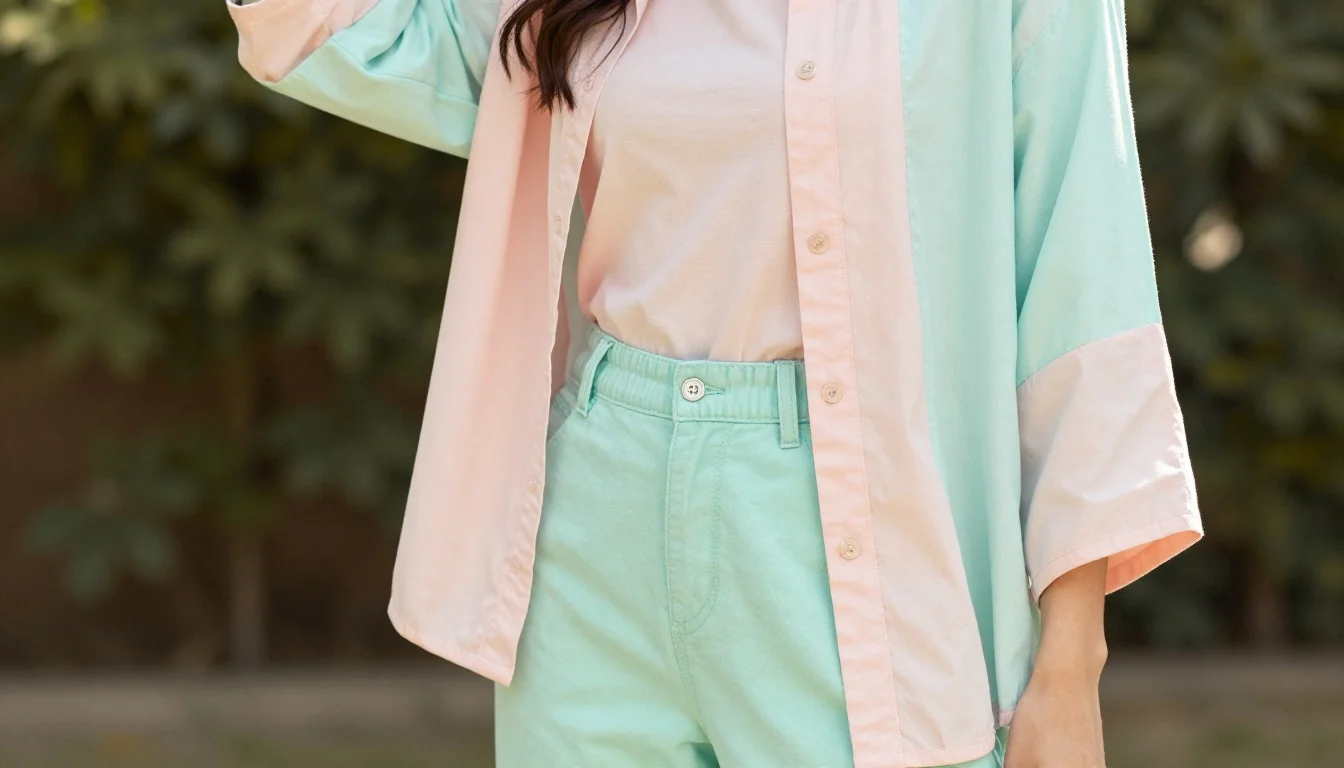
Pastels That Wash You Out
Baby pink on warm or deep coloring
Baby pink is cool-toned and very light. On warm skin, it creates temperature conflict. On deep skin, it lacks the saturation to hold its own. The result: you look tired, or the color looks like it doesn't belong on you. Warm peach or dusty rose are better alternatives.
Icy pastels on muted or soft coloring
Icy pastels — mint, icy blue, icy lilac — have a brightness that overpowers soft, muted coloring. They make Soft Autumn and Soft Summer look greyed out. Muted versions of the same pastel (sage instead of mint, dusty blue instead of icy blue) are the fix.
Warm pastels on cool skin
Peach and butter yellow on cool pink skin creates a clash. The warmth in the pastel fights the coolness in the skin, producing a slightly sallow or uneven look. Cool skin needs cool pastels: powder blue, lavender, and icy pink instead.
Head-to-toe pastel on high-contrast coloring
If you have dark hair and light skin — or deep skin and bright eyes — an all-pastel outfit drops your contrast too low. The outfit looks intentional but your features look muted. Use pastels as accent pieces with a stronger anchor color instead.
Stop guessing — discover your exact palette
See myself in my colorsFind Your Pastel
If pastels have never worked for you, the temperature was probably wrong — not the concept.
Peach fights cool skin's pink base. Cool pastels echo your undertone and brighten your face.
Icy lavender has a cool blue base that clashes with golden warmth. Warm lilac has enough warmth to harmonize.
Bright mint overpowers soft coloring. Sage has a grey undertone that matches your muted quality.
Baby blue lacks the saturation to hold up against deep skin. Rich lilac and warm peach have enough pigment to create intentional contrast.
All pastel drops your natural contrast. A dark anchor piece keeps the pastel looking intentional, not washed.
If white is too bright for your coloring, a warm or muted pastel tee functions as a softer neutral near the face.
Your Season, Your Pastels
Some seasons are built for pastels. Others use them as accents. Your seasonal palette tells you exactly which pastels — and how many — belong in your wardrobe.
Light Spring
Learn moreLight Spring is the pastel queen. Warm peach, butter yellow, soft coral, and warm ivory are your territory. You can wear pastels head to toe because your coloring is already light, warm, and clear. The key: keep your pastels warm. Cool lavender or icy blue will look slightly disconnected.
Light Summer
Learn moreLight Summer wears cool pastels effortlessly. Powder blue, soft lavender, icy pink, and cool rose are your signatures. Your low-contrast, cool coloring means cool pastels look like they belong. Avoid warm pastels like peach or apricot — they introduce warmth that fights your cool undertone.
Soft Summer
Learn moreSoft Summer handles muted pastels beautifully. Dusty rose, muted lavender, sage, and soft periwinkle all harmonize with your greyed, muted coloring. Bright or icy pastels will overpower you. The muted quality in your pastels should match the muted quality in your coloring.
Find Your Exact Pastels
Pastels aren't just for light coloring — they're for anyone who matches the temperature and depth correctly. Your exact seasonal palette identifies which pastels brighten your skin and which ones flatten it. A personalized color analysis takes the guesswork out and gives you a specific pastel range that works every time.
Stop guessing — preview every color on you
Preview Yourself In Your Palette
Get my personalized analysisStop guessing — preview every color on you
Preview Yourself In Your Palette

Related Guides for Who Can Wear Pastels? Find Your Best
Explore more personalized color advice based on your features.
Want to see these colors on you? What Colors Look Good on Me — free to try.
Frequently Asked Questions About Who Can Wear Pastels? Find Your Best
Who can wear pastels?
Light, low-contrast seasons — Light Spring and Light Summer — wear pastels most naturally. But anyone can wear pastels if the temperature matches their undertone. Warm undertones suit warm pastels (peach, butter). Cool undertones suit cool pastels (lavender, powder blue). Deep or vivid coloring should use pastels as accent pieces alongside darker anchors.
What pastels suit warm skin tones?
Peach, apricot, butter yellow, and warm coral pink. These pastels have an orange or yellow base that harmonizes with golden, olive, or peachy skin. Avoid cool pastels like icy blue or lavender on warm skin — they create temperature conflict that makes the skin look slightly sallow.
Can dark skin wear pastels?
Absolutely. The key is saturation. Washed-out baby pastels can look disconnected against deep skin, but pastels with enough pigment — warm peach, rich lilac, soft gold — create beautiful, luminous contrast. Pair pastels with deeper pieces for balance, or choose pastels that connect to your specific undertone.
Why do pastels make me look washed out?
Two common reasons. First, the pastel's temperature doesn't match your undertone — a cool pastel on warm skin (or vice versa) creates a flat, disconnected look. Second, the pastel's lightness doesn't match your contrast level — if your coloring is deep or vivid, an all-pastel look drops your contrast too low. Fix: match the temperature and add a contrast anchor.
What is the most universally flattering pastel?
Soft rose — a slightly muted, neutral pink — works on the widest range of skin tones because it sits between warm and cool. It's not as warm as peach or as cool as icy pink. For warm skin, lean toward dusty rose. For cool skin, lean toward cool rose. It flatters fair, medium, and deep skin when the depth is adjusted.