How to Find YourTrue Skin Undertone
Learn exactly how to find your skin undertone at home using simple tests. Discover how to wear them confidently — matched to your undertone.
Your undertone is the subtle color that sits beneath the surface of your skin — and it is the single most important factor in determining which colors flatter you. Unlike your surface skin tone (which changes with sun exposure), your undertone stays constant for life. Here is exactly how to identify it.


3,000+
happy clients
Why Undertone Matters More Than Skin Tone
Your undertone is the subtle color that sits beneath the surface of your skin — and it is the single most important factor in determining which colors flatter you. Unlike your surface skin tone (which changes with sun exposure), your undertone stays constant for life. Here is exactly how to identify it.
Most people focus on how light or dark their skin is when choosing colors. But two people with identical medium skin tones can have completely opposite undertones — one warm with golden hues, one cool with pink hues — and they will look best in entirely different color families.
Undertone is the underlying color foundation of your skin. Warm undertones have yellow, golden, or peachy bases. Cool undertones have pink, blue, or reddish bases. Neutral undertones have a balance of both, often appearing more beige-olive without a strong lean toward either.
When you wear colors that match your undertone, your skin appears clearer, more luminous, and more even. When you wear colors that clash with your undertone, your skin looks sallow, tired, or uneven — even under the same lighting conditions.

What are the three undertone categories?
The three main undertone categories are warm (yellow, golden, peachy bases), cool (pink, blue, reddish bases), and neutral (a balance of both, or beige-olive without a strong lean). Some systems also identify 'olive' as a distinct category — a complex cool-warm mix common in Mediterranean, Middle Eastern, and South Asian skin tones.
Colors by Undertone Category
Warm Undertone Colors
If you have warm undertones (yellow, golden, peachy under skin), these colors harmonize with the warmth in your complexion and make your skin glow. Earth tones, warm reds, and golden neutrals are your foundation.
Cool Undertone Colors
If you have cool undertones (pink, blue, or reddish under skin), these cool-based colors share the same temperature as your skin and create a harmonious, bright effect. Jewel tones and cool neutrals are your strength.
Neutral Undertone Colors
If you are neutral (balanced warm and cool, or beige-olive without a strong lean), you have the most flexibility. You can wear slightly warm and slightly cool colors, doing best with medium-saturation tones that are not too extreme in either direction.
Universal Colors
Some colors contain both warm and cool elements and work for most undertones. Teal combines blue and yellow. Medium purple balances warm and cool. These are useful for people who are not sure of their undertone yet.

Not sure yet? See it on your face
Start my color analysisHow to Test Your Undertone at Home
The Vein Test
Look at the veins on the inside of your wrist in natural light. Blue or purple veins indicate cool undertones. Green or greenish-blue veins indicate warm undertones. A mix of both suggests neutral. Note: this test is a starting point, not definitive on its own.
The White Paper Test
Hold a piece of brilliant white paper next to your bare face (no makeup) in natural daylight. If your face looks pink or rosy by comparison, you likely have cool undertones. If your face looks yellow or golden, you are likely warm. If you look greyish or olive, cool or neutral.
The Gold vs Silver Test
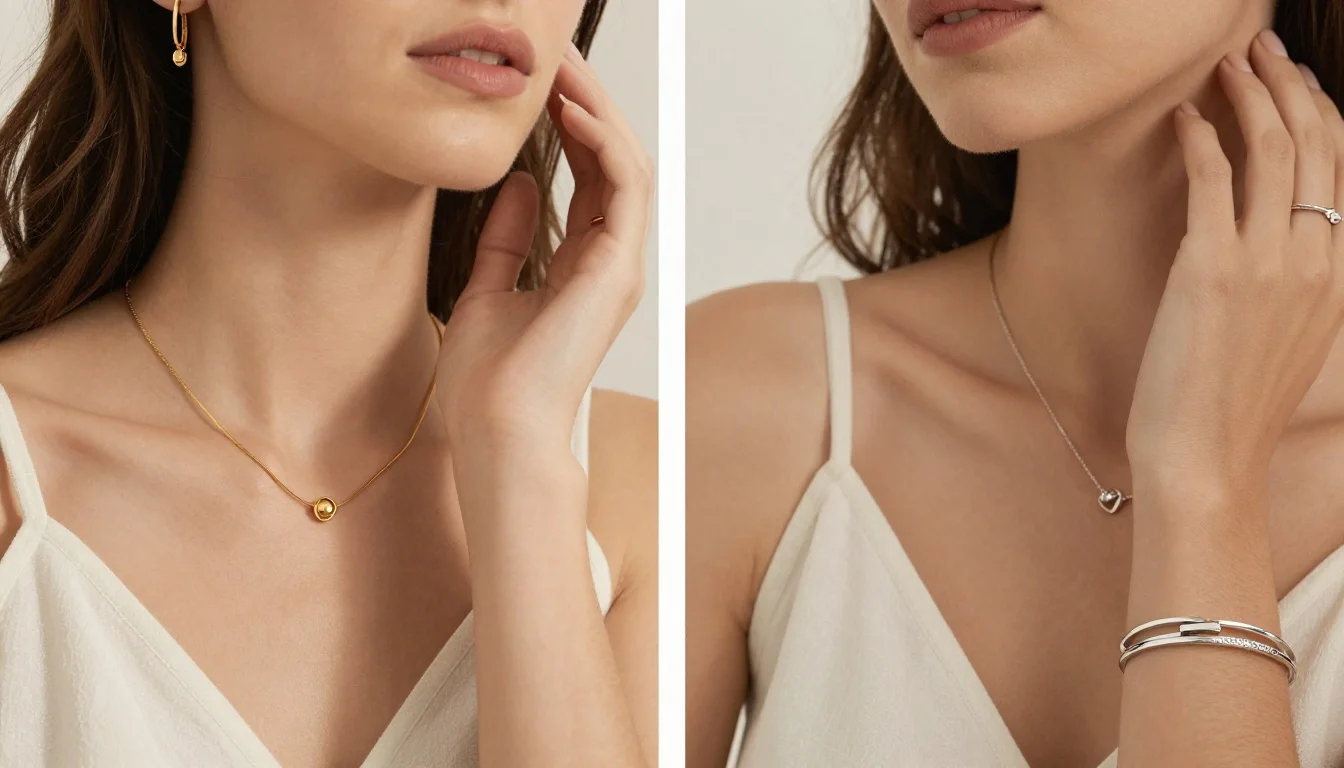
Hold gold jewelry against your skin, then silver. Warm undertones glow next to gold and look dull next to silver. Cool undertones look brightest next to silver and washed out next to gold. If both look equally good, you may be neutral.
The Sun Test
How does your skin respond to sun? Warm undertones typically tan easily and rarely burn (golden or olive skin). Cool undertones burn more easily and do not tan deeply. However, this is influenced by other factors and is only one data point.
Undertone is step one — your season is the full answer
Once you know whether you run warm or cool, the what season am I quiz combines your undertone with value and chroma to pin down your seasonal palette.
Colors That Reveal the Wrong Undertone
Mustard on cool undertones
The strong yellow-orange of mustard clashes aggressively with cool pink undertones. It brings a greenish-grey cast to cool skin that is very unflattering.
Blue-pink on warm undertones
Cool, blue-based pinks (think bubble gum or baby pink) drain warmth from golden and peachy skin tones, making them look sallow and tired.
Bright orange on cool undertones
Pure orange sits at the warm extreme of the spectrum and fights visibly against cool undertones, pulling out any underlying redness and creating a clash.
Ashy grey-brown on warm undertones
Cool, ashy browns with grey undertones look muddy and dull on warm skin. The contrast between the coolness of the color and the warmth of the skin creates a dead-looking quality.
Stop guessing — discover your exact palette
See myself in my colorsUndertone Swaps That Make an Immediate Difference
Once you know your undertone, these swaps make everything work better.
Warm lipstick harmonizes with golden skin; cool lipstick creates a harsh blue-pink contrast.
Warm golden yellow clashes with pink undertones; a cooler yellow harmonizes instead.
Neutral undertones do best avoiding the extremes of either temperature spectrum.
Gold reflects the warmth in warm-toned skin; silver creates a cold contrast.
The warmth of camel fights cool undertones; grey-toned outerwear harmonizes.
Brilliant white reads cold against warm skin; cream creates warmth and luminosity.
Which Palette Might Be Yours?
Your undertone is the starting point for your seasonal color palette. Once you know warm, cool, or neutral, the seasonal system narrows it down further by depth and saturation.
Deep Autumn
Learn moreIf you have warm undertones with medium to deep coloring — golden, olive, or rich skin, dark eyes, hair with warmth — the Autumn palette of earthy, rich tones is likely your home.
Cool Winter
Learn moreIf you have cool undertones with high contrast or deep coloring — pink or blue-toned skin, dark hair, or very fair skin — the Winter palette of clear, vivid cool colors suits you best.
Light Spring
Learn moreIf you have warm undertones with light, delicate coloring — fair or peachy skin, blonde or light hair, light eyes — the Spring palette of warm, light, clear tones is your sweet spot.
Get Your Undertone Confirmed
Self-testing at home gives you a starting point, but the tests are not always clear-cut. Artificial lighting, makeup residue, and the subjectivity of color perception can all throw off your results. A professional color analysis with actual draping — trying fabrics in different undertones next to your bare face — gives you a definitive answer and your complete personal palette.
Stop guessing — preview every color on you
Preview Yourself In Your Palette
Get my personalized analysisStop guessing — preview every color on you
Preview Yourself In Your Palette

Related Guides for How to Find Your Undertone
Explore more personalized color advice based on your features.
Want to see these colors on you? Skin Undertone Test — free to try.
Frequently Asked Questions About How to Find Your Undertone
What are the three undertone categories?
The three main undertone categories are warm (yellow, golden, peachy bases), cool (pink, blue, reddish bases), and neutral (a balance of both, or beige-olive without a strong lean). Some systems also identify 'olive' as a distinct category — a complex cool-warm mix common in Mediterranean, Middle Eastern, and South Asian skin tones.
Can undertone change over time?
No — your true undertone is genetic and permanent. However, your surface skin tone does change with sun exposure, aging, and health. This can sometimes make undertone identification more difficult. Always test in areas that are less exposed to sun, like the inside of your forearm.
What if all the tests give different results?
This is very common and usually means one of two things: you are neutral (balanced between warm and cool), or your undertone is subtle enough that surface lighting and other factors are interfering. In this case, the most reliable test is the gold vs silver jewelry comparison in natural daylight.
Do olive skin tones have warm or cool undertones?
Olive skin is a complex type. It typically has both warm (yellow-green) and cool (blue-grey) components. Most olive skin tones are classified as cool-neutral or warm-neutral depending on which undertone is more dominant. True olive skin often sits in the Deep or Soft seasonal categories.
How does undertone affect makeup?
Undertone affects foundation selection most critically — using the wrong undertone in your foundation makes it look mask-like or off on your skin. It also affects blush, lipstick, and eyeshadow. Warm undertones look best in peachy blushes and warm lipsticks; cool undertones suit berry blushes and pink or red lipsticks.