Wardrobe forRed Hair
Build a wardrobe that makes red hair the focal point. Discover how to build looks with shades that actually flatter you.
Red hair is the most visually dominant feature you own. The goal of your wardrobe isn't to match it, complement it with similar warmth, or try to tone it down — it's to build a foundation that makes your hair the undisputed focal point of every outfit. That means understanding which clothing colors step back gracefully and which ones compete for attention in ways that leave both looking diminished.


3,000+
happy clients
How Red Hair Changes Your Color Strategy
Red hair is the most visually dominant feature you own. The goal of your wardrobe isn't to match it, complement it with similar warmth, or try to tone it down — it's to build a foundation that makes your hair the undisputed focal point of every outfit. That means understanding which clothing colors step back gracefully and which ones compete for attention in ways that leave both looking diminished.
Red hair carries strong warm pigments — copper, orange, and red tones — that are already doing significant visual work. Your wardrobe's job is to frame that warmth, not duplicate it. When you wear clothing in similar warm frequencies (orange, terracotta, rust, warm yellow), the two warm elements blur together. The result is a look that feels muddy and undefined rather than intentional.
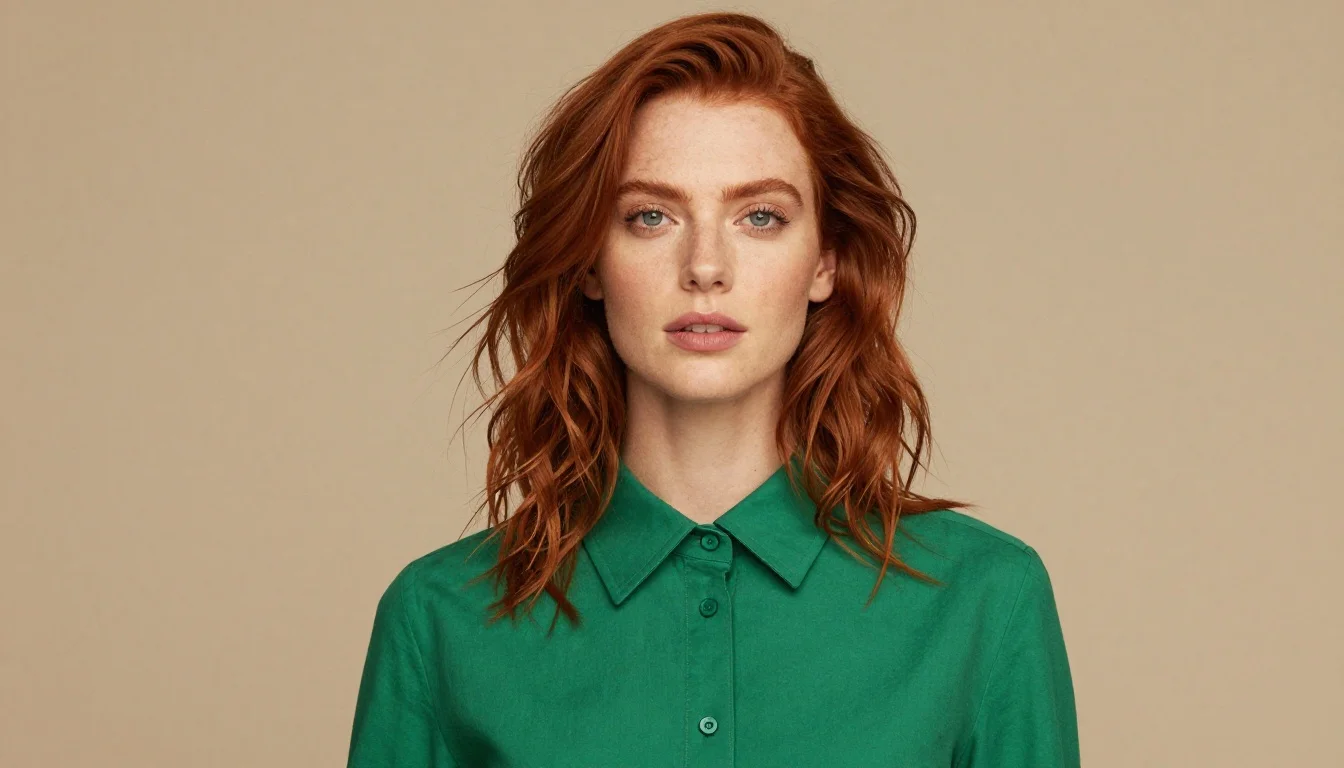
The most important concept for dressing as a redhead comes straight from color theory: green is the complementary color to red. Colors directly opposite each other on the color wheel create vibrant, satisfying visual tension rather than competition. This is why a forest green blouse next to copper hair looks extraordinary — the two colors amplify each other's intensity without either one dominating. It's not a coincidence; it's physics.
Warm neutrals are your wardrobe anchors, not your statement pieces. Navy is a better dark neutral than black (which can fight the warmth of your hair). Cream and ivory work better than stark white. Camel and warm brown create harmony with auburn shades without merging. Once you have these anchors in place, greens, teals, and deep jewel tones become your signature — the pieces that make people stop and stare.
What colors should redheads wear in their wardrobe?
Redheads build the strongest wardrobes around warm neutrals (navy, ivory, camel, chocolate brown) as anchors, greens as the signature statement color (emerald, forest green, teal, sage), cool blues for everyday contrast (cobalt, cornflower, deep turquoise), and jewel tones for depth (deep plum, wine burgundy, deep rose). Green is the most important family — as the complementary color to red on the color wheel, it creates a visual relationship that makes red hair look extraordinary.
Your Core Wardrobe Colors
Warm Neutrals — The Anchor Layer
Every wardrobe needs neutrals that work effortlessly, and for red hair, these five are your foundation. Navy does the job black does for brunettes — it's a powerful dark that contrasts beautifully with red warmth without fighting it. Ivory and warm white give you brightness without the harshness of cool stark white against fair redhead skin. Camel and chocolate brown create a rich, tonal harmony with auburn and copper hair — especially beautiful in coats, blazers, and knitwear. Build your basics here: the navy tailored trousers, the ivory linen shirt, the camel overcoat.
Greens — The Redhead's Secret Weapon
Green is the single most flattering color family for red hair, full stop. Because green and red sit directly opposite each other on the color wheel, wearing green creates a complementary color relationship that makes both your hair and your clothing look more vivid and intentional. Emerald green against copper hair is striking in an almost otherworldly way. Forest green feels lush and editorial. Deep teal bridges green and blue, giving you the complement with an added cool-water quality. Sage is softer and more casual — perfect for everyday knitwear and linen pieces. Invest in at least one hero green piece: a silk blouse, a wool blazer, or a cashmere sweater.
Cool Blues — The Cool Contrast
Cool blues create a different kind of flattery — they use cool temperature contrast to highlight the warmth in your hair. Cobalt blue is a vivid, modern choice that looks electric next to copper hair. Deep turquoise lives between blue and green and offers the best of both: complementary color energy plus cool contrast. Cornflower blue is softer and more wearable for daily use — a cornflower cotton shirt is as effortless as it gets. Denim indigo falls into this family too: dark-wash denim jeans or a chambray shirt are reliable daily pairings for red hair. These blues belong in your everyday and workwear rotation.
Jewel Tones — Sophisticated Depth
Jewel tones in the plum-to-burgundy spectrum offer rich, deep color with a sophisticated quality that suits red hair beautifully. Unlike orange-adjacent tones, these have enough cool or neutral depth to complement rather than compete. Deep plum works as an evening statement or a daytime layer — a plum wool blazer over a cream shirt reads authoritative and distinctive. Wine burgundy bridges warm and cool in a way that harmonizes with auburn shades especially well. Deep rose and rich berry give you something pink-adjacent that's far more interesting than blush. These are your going-out pieces, your event dresses, your standout separates.

Ready to see navy & ivory on your face?
Start my color analysisHow to Build Outfits as a Redhead
The Anchor + Hero Formula
Every great redhead outfit follows the same basic structure: one anchor neutral and one hero color. The anchor does the quiet work — navy trousers, ivory trousers, camel coat, dark denim. The hero is where you let the color theory do its job — an emerald silk blouse, a forest green blazer, a cobalt crew neck. This pairing lets your hair be the third visual element that ties everything together. Avoid wearing multiple statement colors at once; your hair already counts as one.
Everyday and Casual Outfits
For daily dressing, lean on your green and teal pieces as the default alternative to grey (which has no visual relationship with red hair). A sage green knit sweater with dark-wash denim and ivory trainers is an effortless, flattering combination. A forest green hoodie with camel chinos and white sneakers reads polished without trying too hard. For warmer months, a deep teal linen shirt over ivory shorts is a clean summer combination. Keep your basics — the jeans, the shorts, the everyday tees — in navy, ivory, or camel, and you'll always have an easy base to build from.
Work and Professional Dressing
Navy is your most powerful workwear neutral. A navy tailored blazer creates a high-contrast, polished look against red hair that reads both authoritative and distinctive. Pair it with ivory or cream underneath — a silk shell or a fine-gauge knit — for a monochromatic understated base that lets the blazer and your hair lead. For a stronger statement, a forest green blazer with dark navy or chocolate brown trousers is an elevated combination that few can pull off the way redheads can. Avoid khaki and mid-range tan in workwear: the warmth reads unfocused next to red hair.
Evening and Special Occasions
Jewel tones belong at events. A deep plum silk dress against copper hair is genuinely stunning. An emerald satin midi dress against auburn hair is editorial. Cobalt blue is dramatic in the best possible way for occasions where you want to make an impact. Wine burgundy works beautifully for more intimate, romantic evenings — it harmonizes with deeper auburn tones while adding rich depth. The formula for evening is simple: choose one jewel tone piece, keep everything else minimal (gold jewelry works beautifully, silver can work with cooler red shades), and let your hair close the look.
Colors That Compete With Your Hair
Orange, rust, and terracotta
These are the most common wardrobe mistakes for redheads. Orange, rust, and terracotta sit in the same warm frequency as red and copper hair. Wearing them creates a warm-on-warm collision — neither the hair nor the clothing reads clearly. The effect is an undefined, muddy visual where nothing stands out. If you love earth tones, chocolate brown and camel give you warmth and richness without the clash.
Warm mustard and bright yellow
Warm yellows amplify the golden-orange component of red and copper hair rather than contrasting with it. The result is a look that feels washed-out or clashing depending on your specific hair tone. If you want warmth and brightness, pale ivory is the answer — it gives you light without the yellow frequency that fights red hair.
Bright coral and warm salmon
Coral is part orange, which makes it problematic for red hair — especially for ginger and strawberry-blonde shades where the orange overlap is most visible. It creates a discordant clash that makes both the hair color and the garment look less intentional. Deep rose and raspberry offer the same spirit with far more flattery.
Pale peachy nudes
Peachy nudes blend with fair, freckled redhead skin rather than creating definition. Against red hair, they make the overall look lose contrast and cohesion — everything flattens into a similar warm range. Ivory, soft rose, and warm white all give you a light, near-neutral effect with the definition that peach lacks.
Stop guessing — preview every look on you
See these looks on my photoYour Wardrobe, Upgraded
These specific swaps replace warm-on-warm mistakes with pieces that work with your coloring instead of competing with it.
Rust competes with your hair's warm frequency. Forest green uses the complementary color relationship — your hair and the sweater amplify each other rather than clashing.
Camel works as an overcoat or casual layer but reads flat as a blazer next to red hair. Navy creates authoritative contrast. Forest green creates the complementary relationship that makes your hair look extraordinary.
Orange-red against red hair is the worst warm-on-warm collision. Plum, cobalt, and emerald all create the striking contrast that makes your hair pop in evening settings.
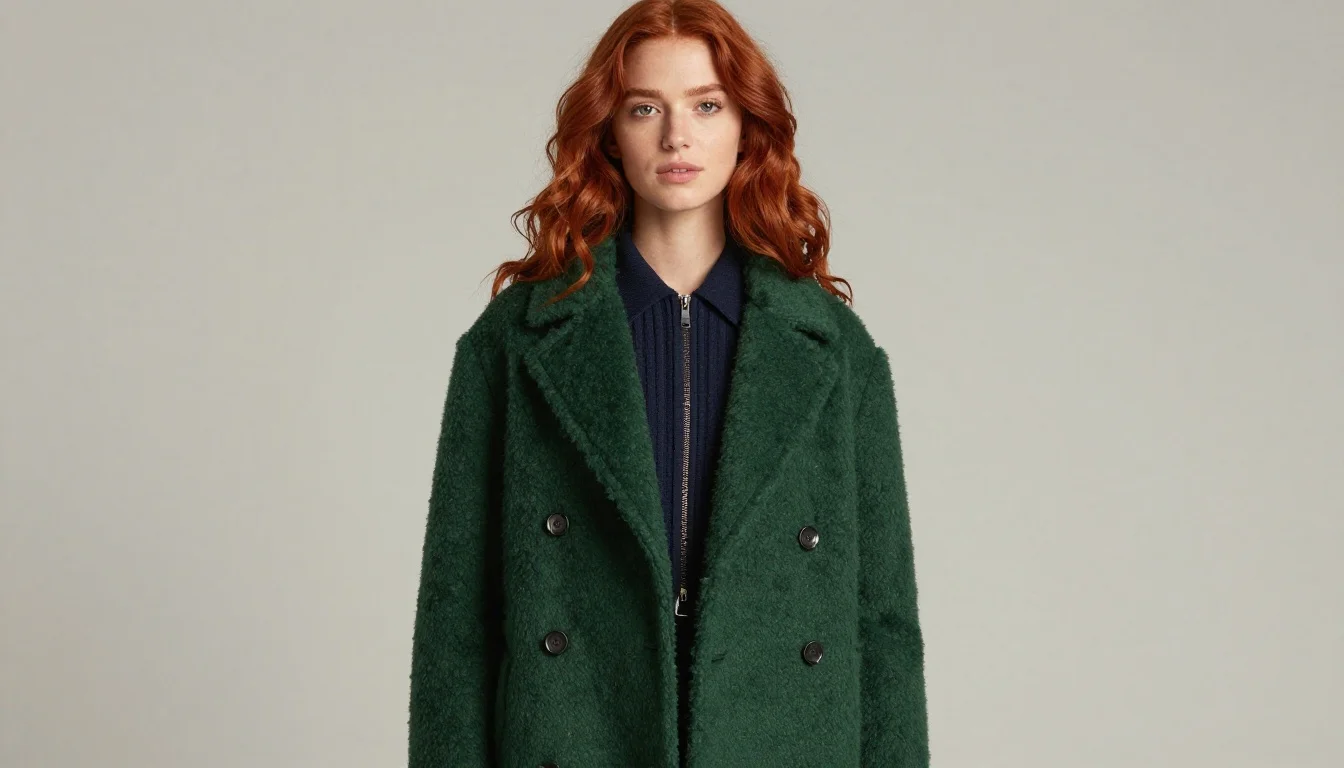
Any red-adjacent outerwear competes directly with your hair across a large surface area. Navy is the most sophisticated alternative. Forest green is bolder but uses the complementary relationship to create a visually cohesive look.
Mustard amplifies the orange-yellow component in red and copper hair rather than creating contrast. Sage green uses the complementary relationship softly. Deep teal adds cool contrast that reads fresh next to warmth.
Peach blends with fair redhead skin and creates an undefined look. Ivory gives you brightness with definition. Soft deep rose has enough cool depth to create a clear edge without clashing.
Your Seasonal Color Palette
Red hair appears across several seasonal color analysis types. The specific palette that applies to you depends on whether your red leans warm and golden (copper, auburn) or cooler and more vivid (strawberry, bright red), along with your skin tone and eye color.
Warm Autumn
Learn moreIf your red hair leans toward rich copper, warm auburn, or chestnut, and your skin has golden or peachy undertones, Warm Autumn is likely your palette. Your wardrobe thrives on depth and richness — the deep greens, navy, camel, and chocolate brown in your core wardrobe families are your natural territory. Even within the Autumn palette, the complementary greens remain your strongest statement color.
Warm Spring
Learn moreIf your red hair is brighter and lighter — strawberry blonde, light copper, or vivid ginger — and your skin is fair with warm undertones, Warm Spring may be your palette. Your colors skew lighter and fresher than Autumn. The greens work just as powerfully; you may also carry lighter, brighter teal with more ease than deeper Autumn shades.
Soft Autumn
Learn moreIf your red hair is muted rather than vivid — a brownish auburn, dusty rose-red, or ash-toned red — and your overall coloring feels gentle rather than high-contrast, Soft Autumn applies. Your wardrobe favors softer versions of the same families: muted sage rather than vivid emerald, dusty teal rather than cobalt, warm camel and soft ivory in your neutrals.
Deep Autumn
Learn moreIf your red hair is very dark — deep auburn, mahogany, or wine-toned red — and your overall coloring is high-contrast with dark eyes, Deep Autumn may be your palette. You can carry the darkest, richest versions of all your wardrobe families: deep forest green, dark navy, chocolate brown, and deep plum. The depth of your hair means you can handle bolder, deeper statement pieces.
Build a Wardrobe That Works With Your Hair, Not Against It
The right wardrobe for red hair isn't about dressing to match or to downplay — it's about using color theory to make your hair look more vivid, your skin look more luminous, and your overall look more intentional. Once you understand the anchor-and-hero framework, getting dressed becomes considerably simpler. Your exact shade of red, your skin's undertone, and your eye color will shift which specific greens, blues, and neutrals work best. A personalized color analysis gives you that precision — the exact shades across every category that make your particular coloring shine.
Stop guessing — preview every color on you
Preview Yourself In Your Palette
Get my personalized paletteStop guessing — preview every color on you
Preview Yourself In Your Palette

Related Guides for Wardrobe for Red Hair
Explore more personalized color advice based on your features.
Want to see these colors on you? Virtual Hair Color Try-On — free to try.
Frequently Asked Questions About Wardrobe for Red Hair
What colors should redheads wear in their wardrobe?
Redheads build the strongest wardrobes around warm neutrals (navy, ivory, camel, chocolate brown) as anchors, greens as the signature statement color (emerald, forest green, teal, sage), cool blues for everyday contrast (cobalt, cornflower, deep turquoise), and jewel tones for depth (deep plum, wine burgundy, deep rose). Green is the most important family — as the complementary color to red on the color wheel, it creates a visual relationship that makes red hair look extraordinary.
Why does green look so good with red hair?
Green is the complementary color to red — they sit directly opposite each other on the color wheel. Complementary colors amplify each other's intensity rather than competing, creating a visually vibrant and satisfying relationship. When you wear green next to red hair, both the hair color and the garment appear more vivid and intentional. This is why forest green against copper hair looks so striking — it's not a matter of personal preference, it's color physics.
What should redheads avoid wearing?
Redheads get the most unflattering results from orange, rust, terracotta, warm mustard, bright coral, and peachy nude tones. These colors sit in the same warm frequency as red and copper hair, creating a muddy warm-on-warm effect where neither the hair nor the clothing reads clearly. Pale peachy nudes are also problematic — they blend with fair redhead skin and drain contrast from the overall look.
Is navy or black better for redheads?
Navy is almost always the better choice. Black can fight with the warmth of red hair, especially for copper and ginger shades — the stark cool-neutral contrast can feel harsh rather than polished. Navy creates a cleaner, more harmonious dark neutral for red hair: it has enough contrast to read as a serious dark color while complementing rather than fighting the warmth. For very dark auburn and mahogany hair shades, black becomes more workable.
Can redheads wear red clothing?
Yes, with one important distinction: cool-toned red, not warm-toned red. A cool, blue-based red (true crimson, berry-red, or wine) sits far enough from the orange-red frequencies in copper and ginger hair to avoid a direct clash. Warm orange-reds are the problem. Deep burgundy is the safest bold-red choice for the wardrobe — it reads as a sophisticated dark with enough cool depth to complement rather than compete with red hair.
What coat color is best for red hair?
Navy and forest green are the best coat colors for red hair. A navy coat is a versatile, timeless choice that creates strong contrast without fighting your hair's warmth. A forest green coat is bolder but uses the complementary color relationship to create a deliberately striking combination. Camel is a beautiful third option for a softer, warmer feel — especially with auburn and chocolate-red hair tones. Avoid brick red, burnt orange, or any rust-adjacent coat: the warm-on-warm clash across the large surface area of a coat is particularly unflattering.