How to WearEmerald Green
Emerald green is one of the most striking and versatile jewel tones. Discover how to wear them confidently — matched to your undertone.
Emerald green belongs to a small category of colors that look inherently expensive. It has the depth of a jewel tone, the versatility of a statement color that nonetheless pairs with neutrals, and a quality of richness that few other greens can match. Unlike forest green (which reads as earthy) or sage (which reads as muted), emerald reads as vivid, luxurious, and deliberate. Worn correctly, it's among the most striking additions to a wardrobe. Worn carelessly, it's overwhelming. The difference is shade selection and pairing.


3,000+
happy clients
Why Emerald Green Is Different From Other Greens
Emerald green belongs to a small category of colors that look inherently expensive. It has the depth of a jewel tone, the versatility of a statement color that nonetheless pairs with neutrals, and a quality of richness that few other greens can match. Unlike forest green (which reads as earthy) or sage (which reads as muted), emerald reads as vivid, luxurious, and deliberate. Worn correctly, it's among the most striking additions to a wardrobe. Worn carelessly, it's overwhelming. The difference is shade selection and pairing.
Emerald green is a saturated, medium-depth green with a clear, vivid quality — it has the brightness of a gemstone without the darkness of forest green or the pastiness of mint. This clarity is what makes emerald work as a statement color: it doesn't need context to make an impact. A single emerald piece in an otherwise simple outfit creates immediate visual interest without requiring additional styling.
The color temperature of emerald is important and often misunderstood. True emerald sits on the cool side of green — it has a blue-green quality rather than a yellow-green one. This cool quality makes it harmonious with cool undertones and skin tones that carry pink or neutral-cool qualities. For warm undertones, the more yellow-toned or forest-adjacent versions of emerald work better than the pure blue-green of true emerald.
Emerald's versatility across occasions is unusual for a jewel tone. Most vivid colors belong to evening or formal contexts, but emerald works in professional settings (a structured emerald blazer is immediately authoritative), casual dressing (a fine-gauge emerald knit with dark denim), and formal events (emerald silk or satin at evening occasions). This across-context flexibility is part of what makes an investment in emerald pieces worthwhile.

What colors go with emerald green?
Black creates the most striking contrast with emerald. Gold and cream provide elegant warmth. Navy creates a sophisticated cool combination. Burgundy adds richness without the Christmas red connotation. Avoid bright red and vivid orange alongside emerald — these compete rather than complement.
Shades of Emerald Green That Work Best
True Vivid Emerald
True emerald has a clear, saturated quality that reads as unmistakably jewel-toned. It sits squarely in the medium-depth range — dark enough to have authority, light enough to retain vibrancy. This is the shade in an emerald silk blouse, a quality knit, or a statement blazer — pieces where the color is the point. Most flattering for cool and neutral undertones where the blue-green quality harmonizes with the skin.
Deep Forest Emerald
Deep emerald pushes toward bottle green and forest — it has more depth and less brightness than true emerald. This version is the most sophisticated and the most wearable as a neutral: deep emerald trousers or a blazer behave almost like a colored dark neutral. It works across all undertones because the added depth reduces the color's intensity. Best in structured pieces — blazers, tailored trousers, coats — where the depth creates authority.
Bright Blue-Green Emerald
Bright blue-green emerald pushes toward teal — it has more blue than classic emerald and reads as more vivid and electric. This is the most attention-commanding version and works best as a single statement piece in an otherwise simple outfit. Exceptionally flattering for cool undertones. Works particularly well in evening contexts where the vibrancy reads as intentional luxury.
Warm Yellow-Green Emerald
Warm emerald has more yellow in it — it bridges the gap between emerald and forest green. This version is most flattering for warm undertones where the yellow quality harmonizes with the skin's warmth. It behaves more like a sophisticated neutral than true blue-green emerald and pairs more naturally with camel, tan, and warm earth tones.

Ready to see emerald & gem green on your face?
Start my color analysisHow to Incorporate Emerald Green in Real Outfits
Emerald with black for maximum impact
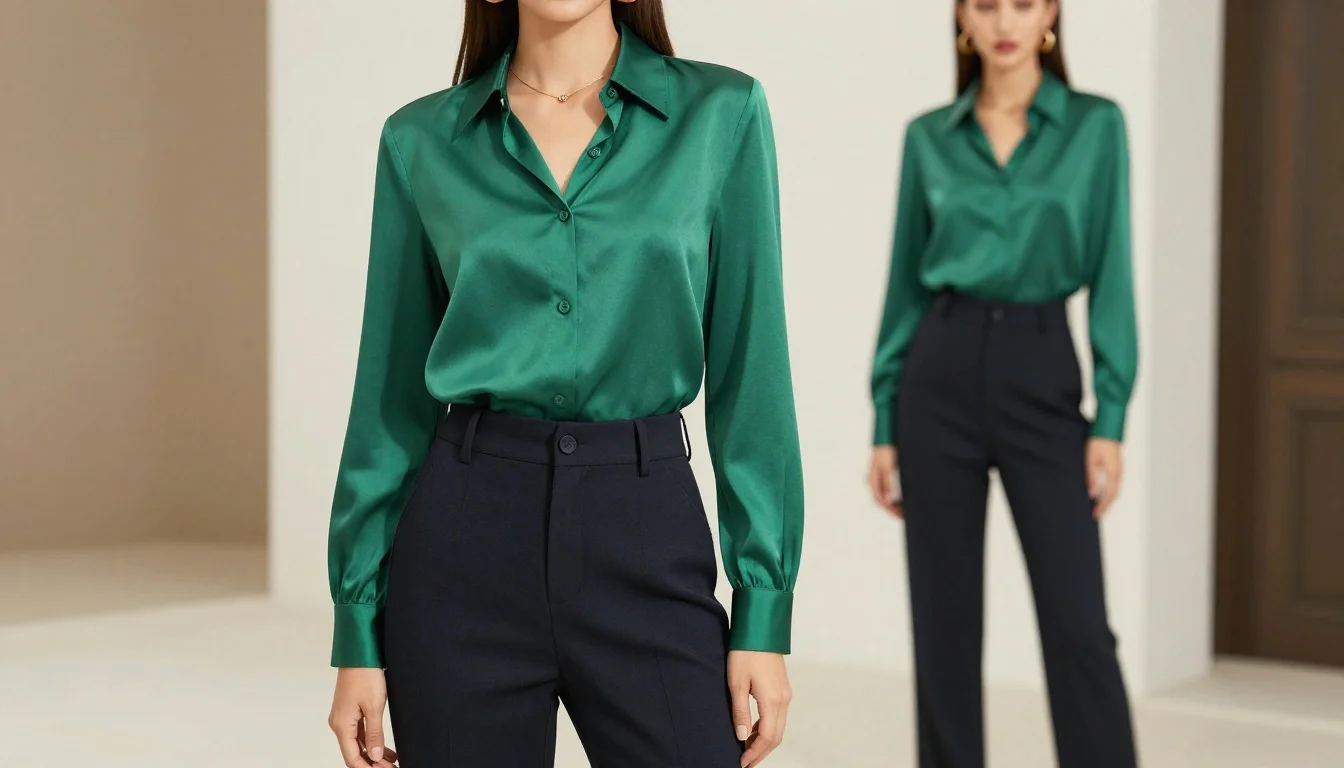
Emerald and black is the highest-contrast emerald pairing and the easiest to style. An emerald blouse with black tailored trousers, or an emerald blazer over a black tee and straight-leg jeans. The black provides complete contrast, allowing the emerald to read at its full vivid intensity. Add gold jewelry for warmth. This combination works in professional, smart-casual, and evening contexts equally.
Emerald as a professional statement
A structured emerald blazer is one of the most effective professional statement pieces available. Worn with ivory or cream trousers and white shirt, or with charcoal or navy tailored trousers, it creates an outfit that reads as considered, creative, and authoritative simultaneously. Add simple gold jewelry and a structured bag. The emerald does all the communicative work — keep everything else simple.
Emerald in evening dressing
Emerald in silk, satin, or velvet is among the most striking evening color choices. A silk emerald dress or velvet emerald top at a formal event reads as genuinely luxurious. Pair with gold or rose gold jewelry, a simple black or gold clutch, and keep makeup dramatic or keep it minimal — both work. Emerald in these fabrics photographs beautifully in low lighting and reads as deliberate confidence.
Casual emerald: the knit formula
A fine-gauge emerald knit — turtleneck, crew neck, or fitted long-sleeve — with dark denim and simple accessories is one of the best casual outfits in this color. The knit keeps the emerald approachable without reducing its impact. Wear with white trainers and simple gold jewelry for the most effortless version, or tan or brown leather boots for more warmth.
What Creates Problems With Emerald Green
Bright red alongside emerald
Red and green together trigger immediate associations with Christmas and seasonal decoration — the combination reads as thematic rather than fashion. Avoid pairing full emerald with vivid red in a single outfit. If you want warm richness alongside emerald, burgundy is the answer — it has the depth of red without the Christmas connotation.
Bright orange with emerald
Vivid orange and emerald is a high-contrast, warm-cool combination that creates visual competition rather than balance. Both colors demand attention and neither wins. If you want warmth alongside emerald, choose rust or deep camel — both provide warmth with less intensity conflict.
Pale, washed-out versions marketed as emerald
Some fabrics in emerald-adjacent colors are made in lower-quality versions that appear grey-green, olive-adjacent, or simply pale. These lack the luminosity of true emerald and read as muted rather than jewel-toned. The richness and clarity of the color is emerald's defining quality — if the green doesn't look vivid, it's not emerald.
Stop guessing — preview every look on you
See these looks on my photoEmerald Green Swaps That Elevate the Wardrobe
Replacing good pieces with emerald and getting something more memorable.
An emerald blazer is as professional as navy but immediately more distinctive — it becomes your signature piece.
Emerald silk is the version of this piece that people remember. Same versatility as black silk, dramatically more presence.
Emerald reads as more considered and luxurious than black at formal occasions — it photographs beautifully and reads as a real choice.
Emerald has the same casual wearability as forest green but significantly more visual impact — a worthy daily upgrade.
An emerald bag is a statement accessory that works with every neutral outfit and becomes the color anchor in any look.
An emerald coat is among the most striking outerwear choices — rich, distinctive, and more interesting than any navy alternative.
Which Seasons Wear Emerald Best
Emerald green appears in both warm and cool seasonal palettes, but the specific shade varies significantly. Your season determines whether you reach for blue-green emerald or the warmer, yellow-toned versions.
Cool Winter
Learn moreTrue vivid emerald is one of Cool Winter's primary colors. The brightness and cool clarity of the shade aligns perfectly with this high-contrast season. Blue-green emerald at full saturation is a core Cool Winter color.
Deep Winter
Learn moreDeep Winter wears the richest, darkest versions of emerald — deep bottle green, dark jewel emerald. The depth of this season means lighter or brighter emerald can look washed out; go deep and rich.
Warm Autumn
Learn moreWarm Autumn wears the yellow-toned, warm versions of emerald — grass emerald, golden-green, warm jewel green. The blue-green of true emerald is too cool; the warm-toned versions that bridge emerald and forest green are right.
Find Your Emerald
Emerald is one of those colors that, once found at the right shade and temperature for your coloring, becomes a wardrobe anchor you return to repeatedly. A personal color analysis identifies exactly which version of emerald — blue-green, warm-toned, deep, or vivid — creates the most luminous result against your specific skin, hair, and eye combination.
Stop guessing — preview every color on you
Preview Yourself In Your Palette
Get my personalized paletteStop guessing — preview every color on you
Preview Yourself In Your Palette

Related Guides for How to Wear Emerald Green
Explore more personalized color advice based on your features.
Want to see these colors on you? What Colors Look Good on Me — free to try.
Frequently Asked Questions About How to Wear Emerald Green
What colors go with emerald green?
Black creates the most striking contrast with emerald. Gold and cream provide elegant warmth. Navy creates a sophisticated cool combination. Burgundy adds richness without the Christmas red connotation. Avoid bright red and vivid orange alongside emerald — these compete rather than complement.
Is emerald green a year-round color?
Yes — emerald works in every season. In lightweight fabrics like silk and linen it works for spring and summer. In wool, velvet, and cashmere it's a strong autumn and winter choice. The color itself has no seasonal limitation; the fabric and weight of the garment determines the season.
Does emerald suit warm undertones?
Yes, with the right shade. Warm-toned emerald (more yellow-green than blue-green) works best for warm undertones. True blue-green emerald can create a cool-warm conflict on very warm skin. If you have warm undertones, look for emerald described as 'forest,' 'warm jewel green,' or 'yellow-green emerald.'
What is the difference between emerald and forest green?
Emerald is more vivid, brighter, and cleaner — it has the clarity and luminosity of a gemstone. Forest green is deeper, more muted, and earthier — it reads as natural rather than jewel-toned. Both are beautiful but they serve different wardrobe functions: emerald as a statement, forest green as a sophisticated neutral.