Minimalist Style Colorsfor Warm Undertones
Minimalist style is all about restraint — but the wrong neutrals wash out warm skin. Discover which shades flatter you most — and which to skip.
Minimalist dressing is about deliberate simplicity — a tight, well-edited wardrobe of neutral and near-neutral pieces that work together effortlessly. But minimalism has a pitfall for warm-undertone skin: the coolest neutrals (stark white, ash grey, cool taupe) actively compete with golden or peachy skin tones rather than harmonizing with them. Your minimalist palette isn't smaller or more restricted — it's simply calibrated to the warm side of neutral. Cream instead of white. Warm sand instead of cool ash. Cognac instead of silver. These shifts are subtle, but they're the difference between a minimal look that drains you and one that makes your skin look luminous.


3,000+
happy clients
Why Warm Undertones Need a Warm Minimal Palette
Minimalist dressing is about deliberate simplicity — a tight, well-edited wardrobe of neutral and near-neutral pieces that work together effortlessly. But minimalism has a pitfall for warm-undertone skin: the coolest neutrals (stark white, ash grey, cool taupe) actively compete with golden or peachy skin tones rather than harmonizing with them. Your minimalist palette isn't smaller or more restricted — it's simply calibrated to the warm side of neutral. Cream instead of white. Warm sand instead of cool ash. Cognac instead of silver. These shifts are subtle, but they're the difference between a minimal look that drains you and one that makes your skin look luminous.
Warm undertones describe skin with yellow, peach, or golden pigmentation beneath the surface. This quality is fixed — it appears regardless of whether your complexion is fair, medium, olive, or deep. It means your skin is naturally harmonious with colors on the warm side of the spectrum and can clash with colors that are distinctly cool or blue-based.
Minimalist style typically leans on whites, greys, beiges, and blacks as its building blocks. The problem is that many common versions of these colors — pure optical white, ash grey, cool mushroom — sit on the cool side of neutral. Against warm-undertone skin, they create a subtle but visible temperature mismatch: your skin looks slightly dull or sallow rather than warm and clear.
The solution is not to abandon minimalism but to select warm-toned versions of every category. Warm ivory for white. Warm taupe or oatmeal for grey. Camel or biscuit for beige. Warm chocolate or espresso for dark neutrals. These choices maintain the clean, restrained aesthetic of minimalism while working with your undertone rather than against it.

What are the best neutral colors for a minimalist wardrobe with warm undertones?
The best minimalist neutrals for warm undertones are warm ivory and cream (instead of pure white), oatmeal and warm sand (instead of ash grey or cool beige), camel and warm tan as mid-tone anchors, and warm chocolate or espresso as dark anchors. Every category has a warm and a cool version — warm undertones consistently look better in the warm variants.
Your Warm Minimalist Color Palette
Warm Ivory and Off-White
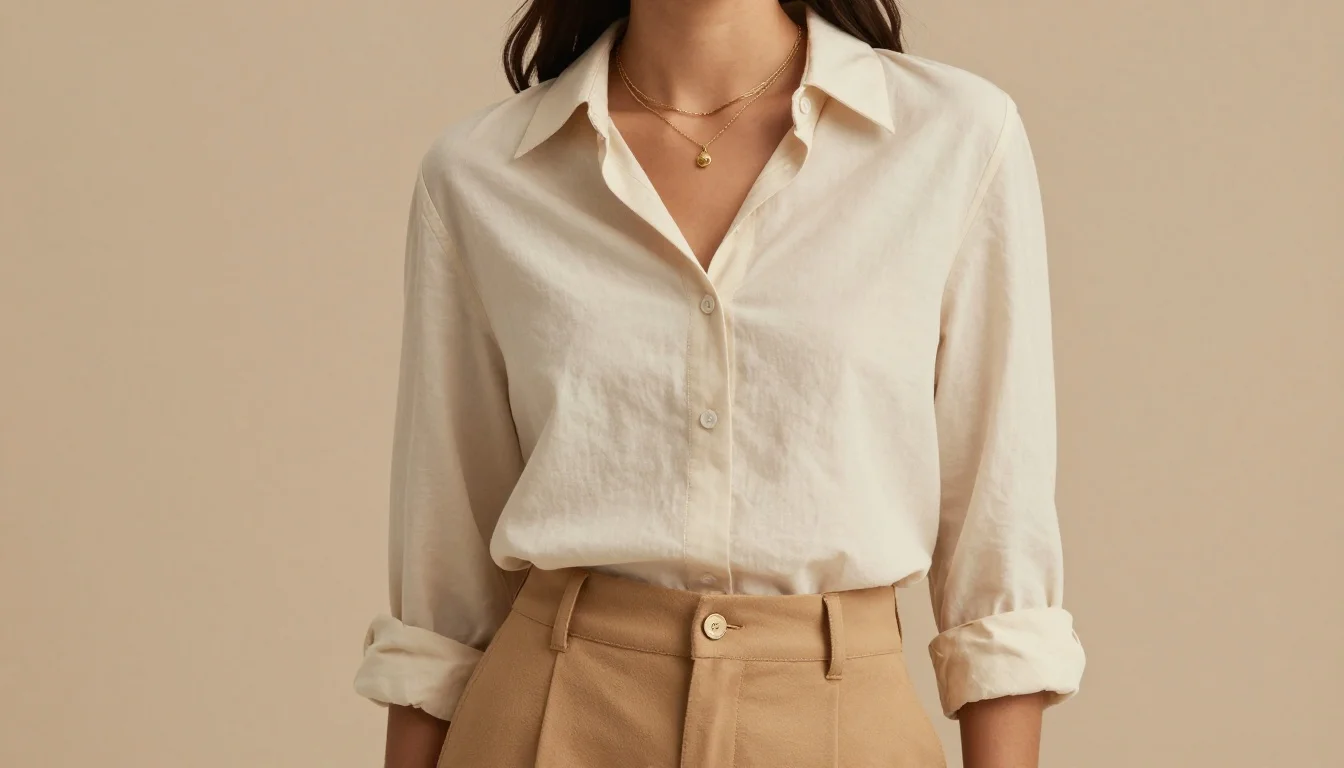
Warm ivory and cream are the foundation of a warm-undertone minimalist wardrobe. Where pure white sits cool and stark against golden skin, ivory has a slightly yellow-warm quality that mirrors your undertone and reads as clean without the conflict. A cream linen shirt or an ivory ribbed knit is the warm-undertone version of the crisp white essential — equally minimal, dramatically more flattering.
Warm Sand and Oatmeal
These mid-ground warm neutrals are the workhorses of a warm minimalist wardrobe. Oatmeal, warm sand, and biscuit carry enough golden warmth to harmonize with warm-undertone skin while remaining visually quiet enough to pair with everything. They function as the warm alternatives to cool mushroom and ash beige — same restrained aesthetic, radically different effect against warm skin.
Camel and Warm Tan
Camel is the most naturally flattering warm neutral for warm undertones and one of the most powerful colors in a minimalist wardrobe. Its golden-brown quality creates a tonal resonance with warm skin that looks expensive and intentional. A camel coat over a cream ensemble is minimalism at its most sophisticated — and the warm palette has a luminous quality in natural light that cool palettes simply cannot produce.
Warm Brown and Chocolate
In a minimalist wardrobe, you need a dark anchor — and for warm undertones, warm chocolate and espresso brown serve that function far better than stark black or cool charcoal. These warm darks create a sophisticated depth without the cool-temperature clash that jet black can create against warm skin. A chocolate brown trouser, an espresso-toned coat, or a cognac leather accessory grounds the palette with richness.

Ready to see ivory & cream on your face?
Start my color analysisBuilding a Warm Minimalist Wardrobe
The core minimalist uniform
Your warm minimalist uniform: a warm ivory or cream top (fitted turtleneck, relaxed linen shirt, or ribbed knit) paired with warm camel, chocolate, or warm tan trousers. Everything in your range from ivory to chocolate brown forms a tonal, monochromatic look that is effortlessly elegant. Add warm gold jewelry — a thin chain or small hoops — and cognac leather loafers. This is your baseline.
Tonal dressing
Tonal dressing — wearing varying shades of the same warm neutral — is one of the most powerful techniques in warm minimalism. Oatmeal top with warm sand trousers and a warm tan coat. Or cream silk blouse with ivory trousers and a camel blazer. The graduated warmth creates a luminous, sophisticated effect. Your warm undertone does the heavy lifting, making what could look beige and forgettable look naturally radiant.
Adding depth without breaking the palette
When you want to introduce depth or structure, reach for your dark warm neutrals — chocolate brown, espresso, deep cognac — rather than black or cool grey. A warm chocolate coat over a cream knit and camel trousers is a complete, sophisticated warm minimalist look. The dark anchor grounds the light palette without the cool-temperature conflict that black can create against warm skin.
Texture over color
In a minimalist wardrobe with a narrow color range, texture becomes your primary tool for visual interest. Linen, cashmere, brushed cotton, suede, and silk all respond differently to light while staying within your warm neutral palette. A cream cashmere crewneck has a completely different visual quality than a cream silk blouse — varying textures within the same color family keeps minimalism interesting without adding complexity.
Minimalist Neutrals That Work Against Warm Undertones
Pure bright white
Optical white has a cool, blue-cast quality that creates a stark temperature contrast against warm-undertone skin. In a minimalist outfit, a pure white shirt or blazer placed near the face will emphasize any yellow or golden quality in the skin in an unflattering way. Warm ivory achieves the same visual crispness without the undertone conflict.
Ash grey and cool greige
Ash grey and cool greige are popular minimalist neutrals — but their cool, blue-grey quality pulls the warmth out of golden or peachy skin, leaving the complexion looking flat. Warm charcoal, warm taupe, and oatmeal are the warm-undertone alternatives that deliver the same visual quietness without the temperature mismatch.
Cool mushroom and cool stone
Many "versatile neutral" beiges are actually quite cool in tone — mushroom, cool stone, and pinkish-grey beiges lean toward cool undertones. They sit awkwardly against warm skin, neither harmonizing nor contrasting clearly. Warm sand, warm biscuit, and oatmeal are the version of this category that flatter warm undertones.
Jet black close to the face
Black is a minimal staple, but its cool, stark quality can create a jarring contrast against warm skin near the neckline. It works better as a bottom, where distance from the face reduces the effect. In minimalist dressing, warm dark brown, espresso, and deep cognac can replace black at the face level with more flattering results.
Stop guessing — preview every look on you
See these looks on my photoWarm Minimalist Wardrobe Swaps
Swapping cool minimalist staples for warm-toned alternatives that keep the aesthetic and gain the glow.
Ivory has the same clean, polished quality as white but with warm undertones that harmonize with golden skin rather than creating a cool temperature conflict.
Oatmeal is the warm-undertone answer to ash grey — equally understated and minimal, but with warm neutrality that makes warm skin look luminous instead of flat.
Warm sand carries just enough golden warmth to echo warm undertones, while cool mushroom creates a subtle temperature clash that dulls warm-toned complexions.
Chocolate and espresso create the same strong dark anchor as black in a minimalist wardrobe, but their warm quality integrates more naturally with warm-undertone skin.
Camel is one of the most flattering outerwear colors for warm undertones — its golden-brown quality creates a harmonious frame around warm-toned faces in a way cool outerwear cannot.
Gold harmonizes with warm undertones; silver creates a visual temperature conflict that disrupts the warmth and cohesion of an otherwise well-calibrated warm minimalist look.
Which Palette Might Be Yours?
Warm undertones in a minimalist context most often correspond to Autumn and Spring seasonal types, where the palette is anchored in golden, earthy, or sun-kissed warmth. Your specific season determines exactly how light or deep your minimal palette should be.
Warm Autumn
Learn moreIf your warm undertones run deep and amber-golden — medium to deep complexion with rich golden warmth — Warm Autumn is likely your season. Your minimalist palette leans into the richest warm neutrals: deep camel, cognac, warm chocolate, and rich olive. Every color has an earthy richness that suits your depth.
Warm Spring
Learn moreIf your warm undertones are light and fresh — fair to medium skin with golden-peach warmth — Warm Spring may be your season. Your minimalist palette uses the lighter warm neutrals: warm ivory, light camel, warm honey, and clear golden tan. Your version of minimalism has a luminous freshness.
Deep Autumn
Learn moreIf your warm undertones are combined with high contrast — dark hair and eyes against warm-toned skin — Deep Autumn may be your season. Your minimalist palette can handle the deepest warm neutrals: dark espresso, rich dark cognac, and the deepest camel tones, with ivory or cream as the contrast light.
Find Your Exact Minimalist Palette
Minimalism with warm undertones is one of the most elegant style combinations when the colors are right — but finding the exact warmth level that works for your specific complexion requires knowing your precise color season. A personal color analysis identifies exactly which warm neutrals — the right ivory, the ideal camel depth, the best dark anchor — give your skin its most luminous, polished result.
Stop guessing — preview every color on you
Preview Yourself In Your Palette
Get my personalized paletteStop guessing — preview every color on you
Preview Yourself In Your Palette

Related Guides for Minimalist Style Colors for Warm Undertones
Explore more personalized color advice based on your features.
Want to see these colors on you? Skin Undertone Test — free to try.
Frequently Asked Questions About Minimalist Style Colors for Warm Undertones
What are the best neutral colors for a minimalist wardrobe with warm undertones?
The best minimalist neutrals for warm undertones are warm ivory and cream (instead of pure white), oatmeal and warm sand (instead of ash grey or cool beige), camel and warm tan as mid-tone anchors, and warm chocolate or espresso as dark anchors. Every category has a warm and a cool version — warm undertones consistently look better in the warm variants.
Can warm undertones wear a minimalist wardrobe in all neutrals?
Absolutely — but the specific neutrals matter enormously. A warm-undertone minimalist wardrobe built on ivory, oatmeal, camel, and warm brown will look radiant and cohesive. The same approach using pure white, ash grey, and cool mushroom will look flat and slightly dissonant. The aesthetic is identical; the palette calibration makes all the difference.
Should warm undertones avoid black in a minimalist wardrobe?
Not necessarily avoid, but use strategically. Black works best away from the face in a warm-undertone minimalist wardrobe — trousers, skirts, or shoes create a clean dark base without the undertone conflict near the skin. At the neckline, warm dark brown, espresso, or deep cognac are more flattering alternatives that maintain the minimal look with better results.
What role does camel play in a warm minimalist wardrobe?
Camel is arguably the single most important color in a warm-undertone minimalist wardrobe. Its golden-brown quality is the ideal mid-tone: warm enough to harmonize with golden skin, deep enough to anchor light cream or ivory pieces, and versatile enough to pair with every other warm neutral. A camel coat or blazer is the warm-minimalist equivalent of the black blazer.
What jewelry metals work with a warm minimalist aesthetic?
Warm yellow gold is the ideal metal for warm undertones in a minimalist setting. It harmonizes with the golden quality of warm-undertone skin and has a quiet, refined quality that suits the minimal aesthetic. Rose gold is a softer option. Silver can create a cool-temperature conflict with warm skin and visually disrupts the warm, unified quality of a warm minimalist palette.