How to DetermineYour Color Season
Learn exactly how to determine your color season using undertone, depth, and contrast. Discover how to wear them confidently — matched to your undertone.
Color season analysis is a method for identifying which colors work best with your natural coloring — and more importantly, why. The system organizes thousands of possible skin, hair, and eye combinations into seasons that share a common color language. Finding your season doesn't just tell you what to wear; it explains the logic behind every good and bad color choice you've ever made.


3,000+
happy clients
Why Your Color Season Changes Everything
Color season analysis is a method for identifying which colors work best with your natural coloring — and more importantly, why. The system organizes thousands of possible skin, hair, and eye combinations into seasons that share a common color language. Finding your season doesn't just tell you what to wear; it explains the logic behind every good and bad color choice you've ever made.
Your natural coloring — the combination of your skin undertone, hair depth, eye color, and the contrast between them — creates a specific visual signature. Colors that share that signature amplify your best features. Colors that clash with it compete with your face, pulling attention toward the wrong things or making your complexion look flat, tired, or uneven.
Color season analysis makes this systematic. Instead of guessing which shade of green might work, you understand the underlying rules: your undertone temperature, your depth range, and how much contrast your coloring can handle. Those three axes determine your season and your palette.
Once you know your season, shopping becomes faster, your wardrobe becomes more coherent, and the compliments start making sense. You're no longer guessing — you have a framework.

What are the four main color seasons?
The four main seasons are Spring (warm, light to medium), Summer (cool, soft to medium), Autumn (warm, muted to deep), and Winter (cool, vivid to deep). Each season shares a common undertone temperature and general color character. The 12-season system further divides each into three sub-seasons for more precision.
The Three Axes That Determine Your Season
Axis 1: Undertone (Warm or Cool)
Undertone is the most important axis. Warm undertones (golden, peachy, yellow-based skin) belong to Spring or Autumn. Cool undertones (pink, rosy, blue-based skin) belong to Summer or Winter. Neutral undertones can lean either way and often fit best in the slightly warmer cool seasons (Soft Summer) or slightly cooler warm seasons (Soft Autumn). The gold-vs-silver jewelry test and the white-vs-cream fabric test are the most reliable ways to identify your undertone.
Axis 2: Depth (Light or Dark)
Within the warm and cool halves, depth separates the seasons further. Light Springs and Light Summers have delicate, low-contrast coloring — pale hair, soft eyes, lighter skin. Deep Autumns and Deep Winters have rich, high-depth coloring — dark hair, dark eyes, deeper skin. Your depth determines how saturated and intense the colors you can wear should be. Light coloring is overwhelmed by very dark, heavy hues; deep coloring can handle them with ease.
Axis 3: Clarity (Muted or Bright)
The third axis is whether your coloring is clear and vivid or soft and muted. Bright Springs and Bright Winters have high-contrast, vivid coloring that calls for clear, saturated colors — soft or dusty shades look grey and lifeless on them. Soft Summers and Soft Autumns have low-chroma, blended coloring that's overwhelmed by very vivid hues — dusty, muted versions of any color harmonize far better.
How the Axes Combine Into Seasons
The 12-season system combines these axes into specific palettes. The four main seasons (Spring, Summer, Autumn, Winter) each split into three sub-seasons. Spring: Light Spring (warm-light-delicate), Warm Spring (warm-medium-clear), Bright Spring (warm-vivid-high-contrast). Summer: Light Summer (cool-light-soft), Soft Summer (cool-muted-neutral), Cool Summer (cool-medium-muted). Autumn: Soft Autumn (neutral-muted-medium), Warm Autumn (warm-medium-muted), Deep Autumn (warm-deep-rich). Winter: Deep Winter (cool-deep-vivid), Cool Winter (cool-medium-vivid), Bright Winter (cool-vivid-high-contrast).

Not sure yet? See it on your face
Start my color analysisHow to Test Your Season at Home
Step 1: Identify your undertone
Start with the fabric test: hold a pure white and a warm cream near your bare face in natural light. One will make your skin look clearer and more luminous. White winning = cool undertone (Summer or Winter). Cream winning = warm undertone (Spring or Autumn). Confirm with the jewelry test: gold flattering = warm, silver flattering = cool. These two tests together give you reliable undertone identification in under five minutes.
Step 2: Assess your depth
Look at your overall coloring: how dark is your hair relative to your skin? Are your eyes light, medium, or dark? Light coloring (fair skin, light hair, soft eyes) points toward the Light seasons — Light Spring or Light Summer. Deep coloring (dark hair, dark eyes, deeper skin) points toward the Deep seasons — Deep Autumn or Deep Winter. Medium coloring leaves more options and requires finer testing.
Step 3: Test clarity — muted or bright
Hold a very vivid, saturated color near your face (think jewel-tone cobalt or vivid coral), then try a dusty, muted version of a similar color (dusty blue or soft terracotta). If the vivid version makes you look alive and the muted version looks grey and flat, you're a bright or vivid season (Bright Spring, Bright Winter). If the muted version harmonizes and the vivid one overpowers, you're a soft season (Soft Summer, Soft Autumn).
Step 4: Narrow to your specific season
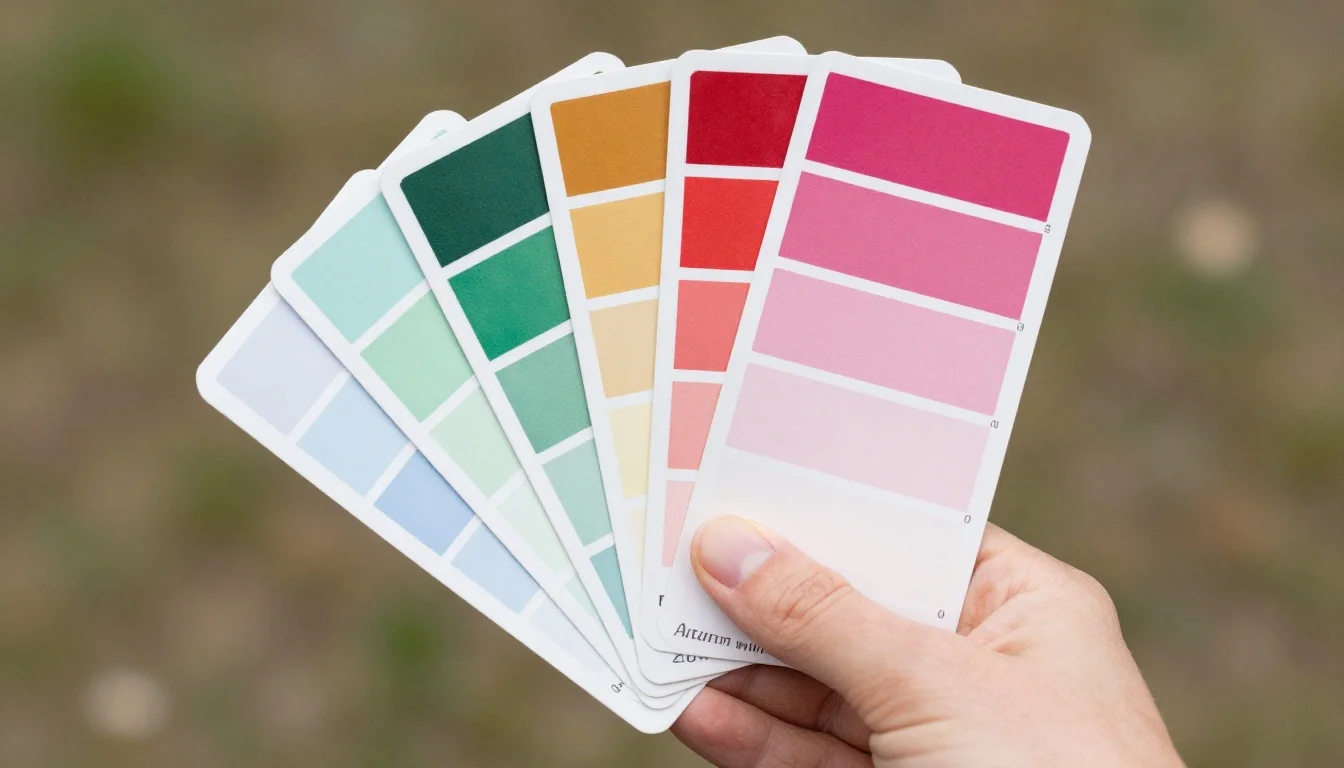
Once you know warm-or-cool and light-or-deep-or-medium and muted-or-bright, you have usually narrowed to two possible seasons. Test swatches from each palette side by side near your bare face. One set will make your eyes pop, your skin look even, and your features come forward. The other set will read okay but won't generate that 'wow' reaction. That contrast is your season.
Rather just answer six questions?
If you'd rather skip the swatches and mirror work, our free seasonal color analysis quiz walks through the same signals — undertone, value, and chroma — and places you in a season in about 3 minutes.
Common Mistakes When Determining Your Season
Judging by surface skin tone alone
Skin darkness is not the same as undertone or season. Deep Autumn and Deep Winter both have dark, rich coloring — but one is warm and one is cool, making their palettes entirely different. Light Spring and Light Summer both have delicate coloring — but they wear completely different colors. Always identify undertone first before looking at depth.
Testing colors on top of makeup
Foundation, blush, and bronzer all mask your true skin undertone, making it nearly impossible to accurately read which colors harmonize with your face. When doing any color testing — fabric draping, the jewelry test, or taking color analysis photos — always do it bare-faced in natural daylight. Even tinted moisturizer introduces enough color shift to confuse the test.
Using artificial lighting
Indoor incandescent lighting adds yellow warmth to everything; fluorescent lighting adds a cool blue cast. Both distort color readings significantly. Always evaluate colors and do tests near a window in natural daylight — ideally overcast daylight, which is the most neutral light source available.
Conflating personal preference with seasonal fit
The colors you love aren't always the colors that love you back. Many people are deep fans of colors that sit outside their season — and that's fine for accessories, home decor, and art. But for clothing near the face, your season's palette is what makes you look your best, independent of aesthetic preference.
Stop guessing — discover your exact palette
See myself in my colorsSeason-Based Color Swaps to Try
Comparing what each seasonal direction looks like in everyday pieces.
White's cool base can wash out warm undertones. Cream mirrors the golden warmth in your skin and reads as clean without the conflict.
Camel's yellow-gold base sits in the warm family and competes with cool undertones. White and soft grey harmonize with pink or blue-based skin.
Heavy dark colors overpower delicate light coloring. Soft, clear light tones harmonize with the low-contrast signature of Light Spring and Light Summer.
Pastels look washed out against rich deep coloring. Deep, saturated versions of the same color family carry the depth needed to match.
Vivid, clean colors overpower soft-muted coloring and look costume-y. Dusty versions harmonize with the blended, gentle quality of Soft Summer and Soft Autumn.
Muted colors look grey and flat against high-contrast bright coloring. Clear, saturated hues match the vivid quality of Bright Spring and Bright Winter.
Which Palette Might Be Yours?
Based on your answers to the three axes — undertone, depth, and clarity — one of these directions will likely resonate. Click through to explore the full palette for each.
Warm Spring or Warm Autumn
Learn moreIf cream and gold both clearly won your tests, you have warm undertones. Light, bright, or golden coloring points toward the Spring family. Deeper, richer, or more muted coloring points toward Autumn. Both seasons share a warm-golden foundation but differ in how vivid and deep the colors should be.
Cool Summer or Cool Winter
Learn moreIf white and silver clearly won your tests, you have cool undertones. Soft, medium, or delicate coloring points toward the Summer family. High-contrast, vivid, or deep coloring points toward Winter. Both seasons share a cool-pink foundation but differ in how saturated and intense the palette needs to be.
Bright Spring or Bright Winter
Learn moreIf you have high contrast between your hair and skin, vivid eye color, and find that muted colors look grey on you, you're likely in one of the Bright seasons. Bright Spring is warm-toned and vivid; Bright Winter is cool-toned and vivid. Both need clear, saturated colors with no muddiness.
Find Your Exact Colors
Knowing your season is the foundation — but the real value comes from knowing the specific shades within it. Not all blues are right for Cool Winter; not all earthy tones are right for Deep Autumn. A personalized color analysis identifies the precise palette that works for your exact combination of undertone, depth, and contrast — giving you a roadmap that makes every color decision simpler.
Stop guessing — preview every color on you
Preview Yourself In Your Palette
Get my personalized analysisStop guessing — preview every color on you
Preview Yourself In Your Palette

Related Guides for How to Determine Your Color Season
Explore more personalized color advice based on your features.
Want to see these colors on you? What Colors Look Good on Me — free to try.
Frequently Asked Questions About How to Determine Your Color Season
What are the four main color seasons?
The four main seasons are Spring (warm, light to medium), Summer (cool, soft to medium), Autumn (warm, muted to deep), and Winter (cool, vivid to deep). Each season shares a common undertone temperature and general color character. The 12-season system further divides each into three sub-seasons for more precision.
How do I determine my color season at home?
Start with the undertone test: hold pure white and warm cream near your bare face in natural daylight. White winning = cool (Summer or Winter). Cream winning = warm (Spring or Autumn). Then assess depth (how dark is your overall coloring?) and clarity (do vivid or muted colors work better?). These three axes narrow you to one or two seasons.
Can my color season change over time?
Your underlying genetic coloring doesn't change, but your apparent season can shift as your hair lightens, darkens, or greys with age. Someone who was a Deep Autumn at 30 may find they're reading more like a Soft Autumn at 60 as their hair lightens and contrasts shift. Professional color analysts will always analyze you as you currently are, not as you used to be.
What is the difference between the 4-season and 12-season systems?
The 4-season system (Spring, Summer, Autumn, Winter) identifies your broad temperature and character. The 12-season system divides each of those into three sub-seasons — for example, Spring becomes Light Spring, Warm Spring, and Bright Spring. The 12-season system gives more precise color guidance, especially for people who don't fit squarely into the classic seasonal types.
Is color analysis based on science?
Color analysis is based on color theory — specifically on how optical harmony and temperature create visual effects on the human face. When the temperature of a color matches the temperature of the skin's undertone, the skin looks clearer and more even. This is a real and consistent optical phenomenon, not guesswork. The seasonal categories are a practical framework for applying this principle to wardrobes.
What if I fall between two seasons?
It's common to have characteristics of two adjacent seasons — for example, the overlap between Soft Autumn and Deep Autumn, or between Light Spring and Light Summer. When this happens, look at which season's palette resonates more when you hold swatches near your bare face in natural light. The right palette will make your eyes brighter and your skin more even. Also consider which season's 'avoid' colors truly do drain you — that's often the clearest signal.